The cash flow of the side buying memory is narrowing toward 2028
1. Two sentences that landed in the same week
On July 9, 2026, OpenAI released GPT-5.6 alongside ChatGPT Work, an enterprise agent. The same day, Sam Altman said that "every company now weighs what it spends on AI against the value it gets back," and cut the price of one new tier in half. The side selling AI had publicly acknowledged the pressure of ROI.
Yet the same week, another company making that AI moved in the opposite direction. Anthropic increased its compute commitments. The deal it signed with xAI (SpaceX's Colossus) in May runs to $1.25 billion per month through May 2029 — $45 billion over three years. And on July 17, reports emerged that Anthropic was in talks to lease $10 billion of compute from Meta over two years. It already holds a separate $40 billion, five-year, one-gigawatt TPU deal with Google.
The pressure to justify spending, and the act of increasing it, landed in one week. That collision is this piece's question. If AI keeps getting cheaper and more efficient, yet compute commitments keep rising — where does that money come from? And how long does it keep coming?
The previous piece traced, through twelve documents, why memory crashed in the week of record earnings. Most of the bear cases were half in the source, or the wrong place, or not 2027. Only one grew heavier when the source was opened — not memory, but the financing of the side buying it. This piece opens that one.
2. The risk the supplier named
Start with the vanguard of the bull camp. SK Hynix sees 2027 as "the worst year in the industry's history from a supply standpoint," demand at 5–6x supply, and demand exceeding supply even beyond 2030. "Not a cycle, but a structural shift."
But what matters in this bullish testimony is what it did not name as a risk. The risk SK Hynix named was not weakening demand. It was geopolitics driving energy prices, and enormous capital requirements. The supplier itself took demand off the risk list and put financing on it. The vanguard of the side selling memory located the real danger not in memory, but in the money of the side buying it.
So the question narrows to one. Can the hyperscalers recover this spending in cash?
3. Not yet — but narrowing
The direction of that answer is read in the filings. Placing side by side the Q1 2026 cash flows of five hyperscalers — Alphabet, Microsoft, Amazon, Meta, and Oracle — filed with the SEC, the gap between the cash earned (operating cash flow) and the cash poured in (capex) has narrowed differently for each.
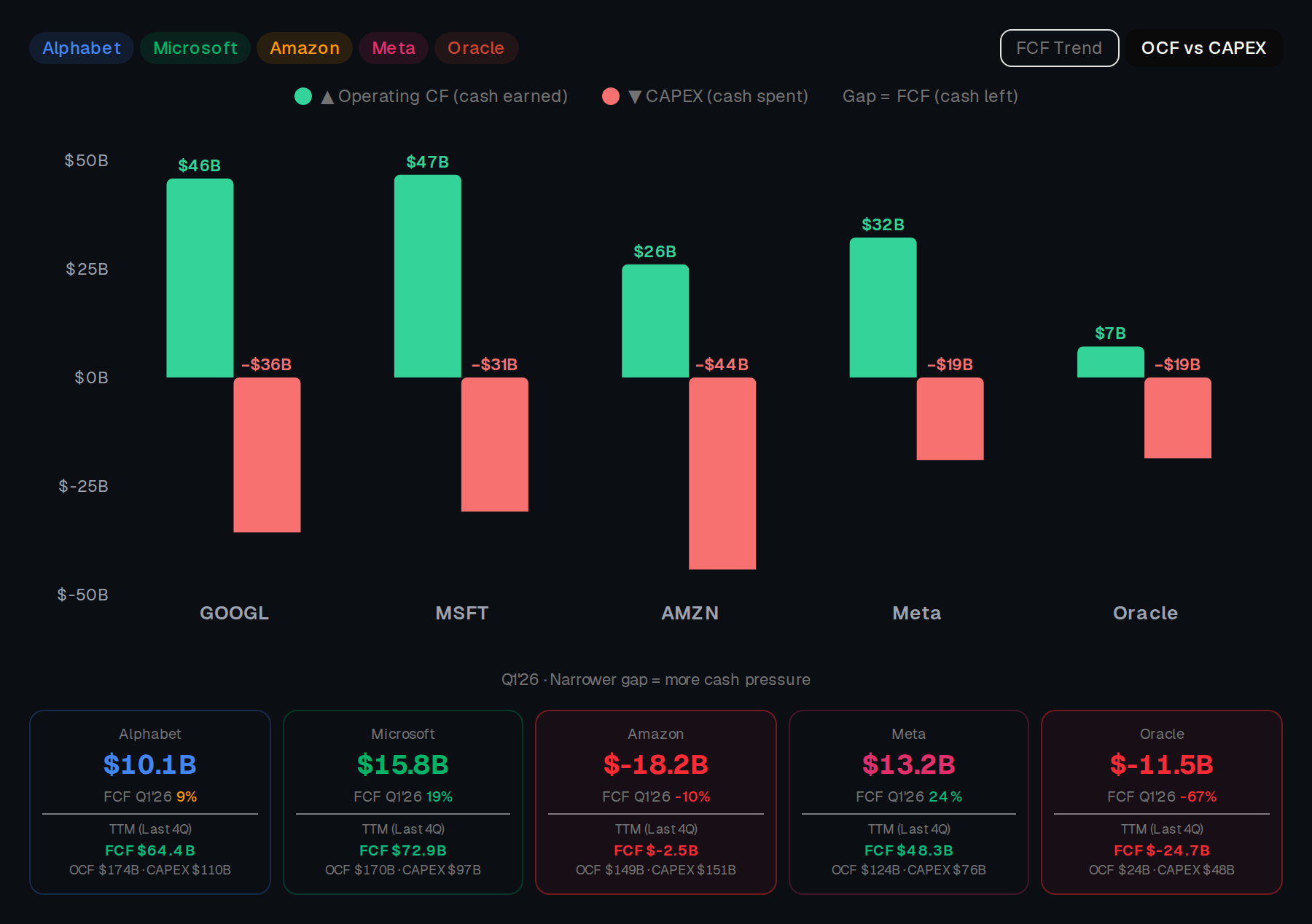
Q1 2026 operating cash flow (earned) and capex (spent) for five hyperscalers · narrower gap = more cash pressure · SEC-filed gross basis (differs from Amazon's own net definition) · Source: SEC 10-Q/K
Alphabet and Microsoft still earn more than they spend. But Amazon, with $26 billion of operating cash flow against $44 billion of capex in the quarter, has turned negative on a gross-capex basis, and Oracle — earning just $7 billion to begin with — reveals the thinnest headroom the moment it spends $19 billion. Same cycle, five different gaps.
And that gap narrows over time. According to a model that Epoch AI built by aggregating the five companies' quarterly reports, operating cash flow is growing about 23% per year while capex grows about 70%. Extrapolating those growth rates, aggregate free cash flow passes zero in Q3 2026. Not an observed event, but the point a trend model built on filings points to. In aggregate it is still positive, but the speed at which the two curves narrow points clearly in one direction. The trajectory of each company crossing that line in a different quarter is seen again at the end of this piece.
There is an opposite face here too. Bank of America sees hyperscalers' debt-to-cash ratios actually improving, most entering net-cash positions, with operating cash flow recovering by 2029. This is not a claim that financing heads for catastrophe. But that the era of "building with your own cash" is ending — this is a fact both bull and bear acknowledge.
4. From own cash to debt
So the mode of financing changed. Alphabet issued $20 billion of corporate bonds in February 2026, including a 100-year tranche. It is the first time an investment-grade tech company has issued a century bond since Motorola in 1997. One research note read the issuance as Alphabet recognizing its free-cash-flow shortfall months ahead and securing funds at favorable rates.
This is a symbol. A company that built data centers with its own earnings has begun taking on 100-year debt. The hyperscalers issued over $121 billion in corporate bonds in 2025 alone, holding more debt than cash for the first time. In one bond manager's words, the old unwritten rule — "AI spending is funded from cash generated" — has broken. That financing shifted from retained earnings to capital markets is a fact confirmed in SEC filings.
5. The debt you cannot see
What appears in the filings is half the pressure. The other half sits off the balance sheet.
Moody's found that lease commitments not yet broken ground reach 113% of hyperscalers' adjusted debt. Through special-purpose vehicles and joint ventures with private-credit firms, a company holds a minority stake while the associated debt stays off its own balance sheet. In Oracle's case, prepayments and customer-supplied hardware arrangements total $75 billion — the cost of GPUs pushed onto customers.
So if the disclosed FCF pressure is the "visible" part, the off-balance-sheet leases and equity structures are the "invisible" part. And the invisible side is larger than the visible one.
6. The question that always returns — ROI
For all this financing to be justified, one thing must ultimately hold. Does AI make money?
Half is already proven. At the task level, verified success is real. Klarna cut $60 million with AI agents; JPMorgan runs over 450 AI use cases in production every day. Companies adopting agentic AI report an average 171% return on investment.
The other half is not yet. According to an MIT study, despite $30–40 billion in enterprise generative-AI spending, 95% of pilots produced no measurable P&L impact. And the cause of that failure was not the models' capability but enterprise integration, data governance, and workflow. It is not a problem solved by placing a bigger model on top.
Here is this piece's reversal. Hyperscaler spending is not staked on "if the model gets bigger, it sells." It is staked on "the agent absorbs the friction of integration, so task-level success converts into company P&L." The ChatGPT Work that Altman unveiled on July 9 is precisely the product of that bet, and Anthropic's compute commitments run the same direction. Yet in that same July, a Chinese open-weight model climbed to the frontier on efficiency, and one of America's strongest labs delayed its release. That pressure — efficiency rising, competition wavering — could shake the justification of the spending before scaling arrives. (The structure of that pressure — efficiency innovation and Chinese memory — the next piece opens separately.)
7. The front line — Oracle
There is one point where bull and bear agree. Oracle.
Oracle's fiscal 2026 free cash flow was −$23.7 billion, projected to stay negative through 2029. Its financial headroom is the thinnest of the five — and the character of that thinness differs from Amazon's. Amazon earns a lot (large operating cash flow) but spends even more; Oracle's earnings themselves are the smallest of the five at $7 billion a quarter, so the moment it spends $19 billion the gap overwhelms the earnings. It is the front line not because it spends the most, but because it earns the least. On top of that sits the structure that pushed $75 billion of capex onto customers through prepayments and customer-supplied chips. In Epoch's model too, Oracle is the only one whose capex has already overtaken operating cash flow, and even Bank of America sees only Oracle as vulnerable.
The point where this piece's question — financing — is tested first is, as far as the data points, Oracle. While the other four head toward the same line in different quarters, Oracle already stands beyond it.
8. Bottom line
The crossover has not yet come. But the speed of the narrowing, the shift from own cash to debt, the commitments off the balance sheet, and Oracle already past the line — these four point one way. The sustainability of the financing is tested somewhere between 2027 and 2028.
This observation predicts no direction. It only records what the market is repricing. One market commentary compresses it — if either the hyperscalers' free cash flow, or whether the bond market keeps buying their paper at investment-grade rates, breaks, the AI capex cycle "stops being a story about ambition and becomes one about access." The companies betting the most on AI are now, for the first time, betting with money that is not theirs.
And the trajectory of that money differs by company. In the same AI capex cycle, five companies write different cash sentences.
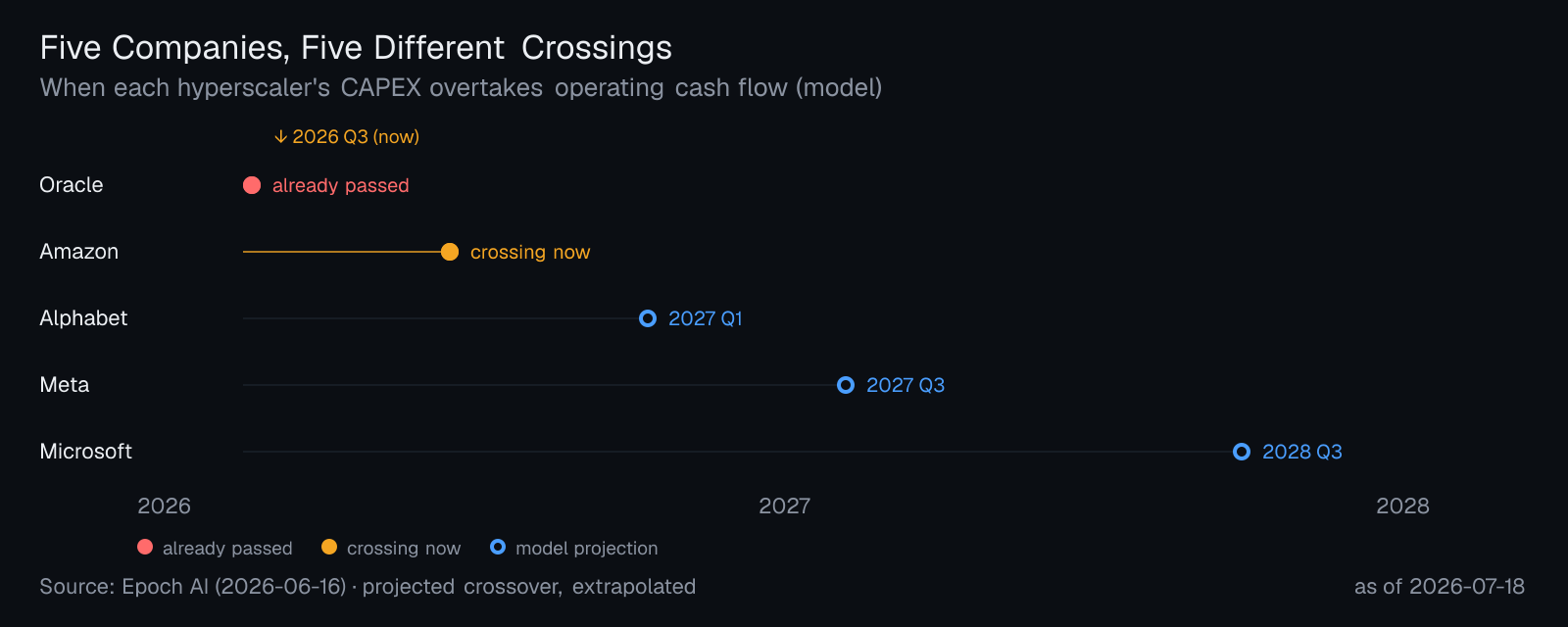
Five companies cross the same line in different quarters · Oracle already, Amazon crossing now, the rest are model extrapolations · Source: Epoch AI (2026-06-16)
Oracle's capex has already overtaken operating cash flow, and its free cash flow stays negative through 2029 — first among the five, and deepest, the point where financing pressure is tested first. Amazon's trailing free cash flow has turned negative at −$2.5 billion on a gross-capex basis (slightly positive under its own net definition), crossing that line now. Alphabet in Q1 2027, Meta in Q3, Microsoft in Q3 2028 — Epoch's model sees the five crossing the same line in different quarters. If the earnings of the three companies selling memory — Samsung, SK Hynix, Micron — are tied to the cash curves of these five, then that curve is not one line but five.
This piece records those five lines. It does not tell you which side to stand on.
Sources and verification
- 5-company OCF vs CAPEX (Q1'26 actual) · SEC 10-Q/K ◎ — quarterly operating cash flow and capex for Alphabet, MS, Amazon, Meta, Oracle. §3 bar chart. Gross-capex basis (same yardstick across companies)
- FCF crossover model · Epoch AI (2026-06-16) ○ (model estimate) — 5-company aggregate model extrapolating OCF +23%/yr, capex +70%/yr growth. Aggregate FCF reaches 0 in Q3 2026 (per model). By company: Oracle passed / Amazon crossing / Alphabet Q1 2027 / Meta Q3 2027 / Microsoft Q3 2028. §8 distribution chart. ※ a trend model, not observed data
- Amazon TTM FCF −$2.5B (gross-capex basis, SEC: TTM OCF 148.5B − CAPEX 151.0B) · SEC 10-Q ◎ ※ slightly positive under Amazon's own net definition (net of sales/incentives) — definitional difference noted
- Alphabet Q1'26 FCF $10.12B (−47% YoY), 2026 full-year ~$8.2B projected · multiple reports ○
- Alphabet 100-year bond = part of $20B February bond, first investment-grade tech century bond since Motorola 1997 · multiple reports ○
- Hyperscaler bonds $121B+ issued in 2025, debt exceeded cash for the first time · multiple reports ○
- Off-balance-sheet leases = 113% of adjusted debt · Moody's ○
- Oracle FY26 (2025-06 to 2026-05) OCF 31.98B − CAPEX 55.66B = FCF −23.68B · SEC 10-K (CIK 1341439) ◎ · negative through 2029, prepay/customer-chip $75B · multiple reports ○
- Anthropic–xAI $45B/3yr, $1.25B/month, through May 2029 · SpaceX SEC S-1 ◎
- Anthropic–Meta $10B/2yr (in talks, not signed) · NYT·CNBC·Reuters (2026-07-17) ○
- Anthropic–Google TPU $40B/5yr, 1GW · multiple reports ○
- GPT-5.6 · ChatGPT Work · price cut · OpenAI announcement (2026-07-09) ◎
- ROI use-case (Klarna $60M, JPM 450 cases, agentic avg 171%) / P&L 95% failure · MIT·multiple reports ○
As of 2026-07-18. Deals in talks are not yet signed, and the FCF crossover dates are extrapolations from a predictive model. This piece is a record of observation at the industry and cycle level, not individual investment advice.
If this analysis was helpful · ☕ Support Us · ✈️ Telegram