Open the source, and the bear case sits in 2028, not 2027
1. The week the peak began to fall
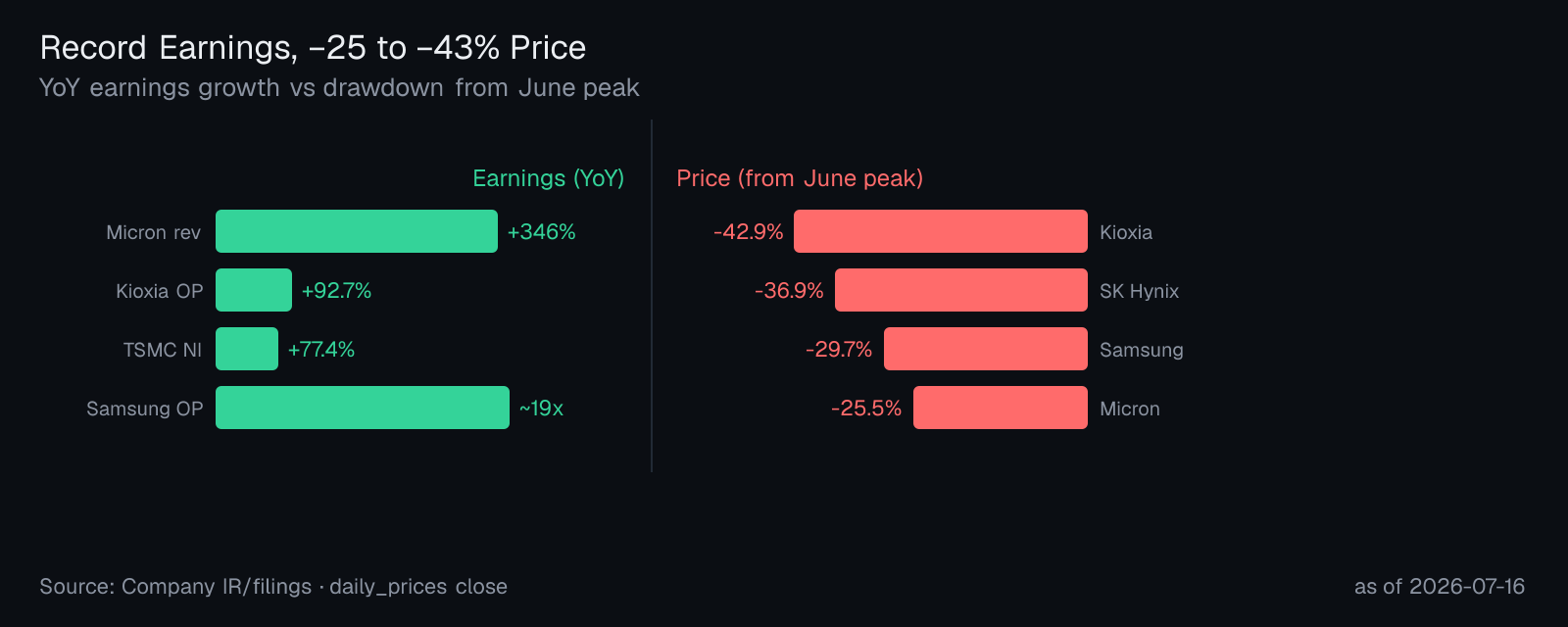
On June 24, 2026, Micron reported fiscal Q3 results. Revenue of $41.46 billion cleared the $35.84 billion consensus by a wide margin, earnings per share beat by 23.8%, and gross margin jumped from 37.7% a year earlier to 84.6%. The stock rose 15% right after. It was the best quarter in the company's history.
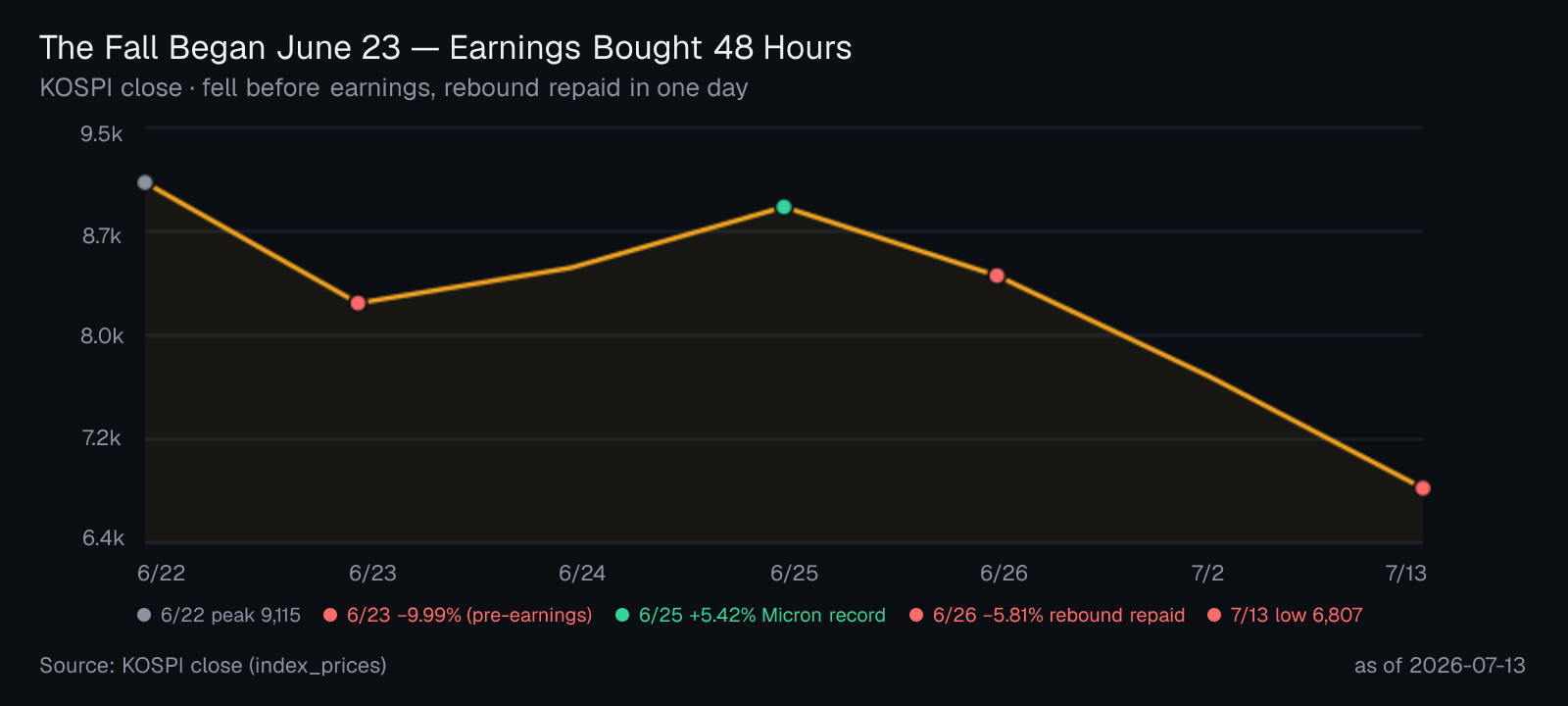
The fall had started the day before. On June 23, the KOSPI dropped 9.99% — the largest point decline on record, and the fifth-largest by percentage. Samsung and SK Hynix posted their worst drops since the 2008 financial crisis, and Micron fell 13.18% that day. The protagonists of the earnings collapsed before the earnings even arrived.
That collapse started from a peak. Micron had risen 700% over the prior twelve months, 40% in the prior month alone. SK Hynix was up 730% over twelve months, and in mid-June the KOSPI crossed 9,000 for the first time, closing at 9,052 on June 19. The market turned not on earnings, but on a price that had already priced those earnings several times over.
And once it turned, reasons kept being supplied. On July 1, Meta's reported sale of surplus compute was read as a signal of capex discipline. On July 6, a Fed note flagged proximity to the dot-com peak, and the same day Morgan Stanley diagnosed the end of the semiconductor upcycle. On July 13, Korea Investment & Securities projected that SK Hynix's Q2 results would come in below consensus, and the stock fell 15% that day. The deeper the decline, the more bear cases appeared.
From 9,052 on June 19 to 6,806 on July 13, the KOSPI fell about 25% (measured from the June 22 closing high of 9,114, it is also −25%). In that span Micron reported the best quarter in its history, and the companies' Q2 earnings estimates were revised up, not down. Earnings were setting new peaks; the stocks were collapsing from theirs.
One question remains. If it was not earnings that broke, then what were all those bear cases explaining? And do their source documents say the same thing the summaries did?
2. The fall did not wait for earnings
To explain the crash, you first have to fix when it started. The conventional answer is July. But walking back through the trading days, the origin is June 23 — and that date overturns one fact: the fall began before earnings, before the U.S. market even opened.
On June 23 the KOSPI dropped 9.99% and Micron fell 13.18%. Yet on the prior U.S. session, June 22, Micron had closed up 6.82%. This was not a decline imported from the U.S. It was a selloff that originated in Asian trading, and that day's news specifies the cause. Right after the open there was a note of euphoria — SK Hynix had overtaken Samsung in market capitalization for the first time in 25 years. Intraday, a drop in GPU rental prices spread into doubt about AI profitability. By the close it was framed as post-rally profit-taking. The amplifier was leverage — the unwinding of single-stock leveraged ETFs mechanically compounded the selling. Earnings did not exist as a variable in this drop. Micron had not yet reported.
Those earnings came two days later, and the market bought them in advance, then confirmed them late. On June 24 the KOSPI rose 3.26% — before the report. Expectations that "Micron sold out of HBM" implied a strong quarter drew buyers in. On June 25, when the results actually landed, the KOSPI rose 5.42%, the largest single-day gain of the stretch. Revenue was 4.5x the prior year, and $1 billion of HBM4 had already shipped for Vera Rubin in three months. Micron itself jumped 15.74% that day, setting its June high. The record earnings bought buying in Korea and the U.S. at once.
And that two days' worth was lost in one. On June 26 the KOSPI fell 5.81%. Earnings had not turned bad — they were, in fact, a record. The seed of the decline was a logic that reinterpreted the earnings. The day before, one outlet had read the surge in legacy DRAM prices as "a signal that the HBM boom had reached a cycle peak." Good news was flipped into a marker of the late cycle. On top of it came SK Hynix's Nasdaq ADR issuance (roughly 2.5% dilution).
The paradox of the peak holds here. The fall began before earnings were reported; earnings could buy a two-day rebound, but that rebound was repaid in a single day. What the record earnings bought was 48 hours. Had earnings been the problem, the report should have reversed the direction. Instead it bought only a rebound, and could not turn the trend. What broke was not earnings, but a price that had already priced them several times over.
The remaining question is what comes next — what did the bear cases pouring out as the decline deepened add to this unwinding of an overheated price?
3. The first fracture: opening the Fed
There are two layers of verification. Public primary documents are quoted directly. Where the source is paywalled or unpublished, the check is only whether multiple reports carrying the same content agree. Neither layer leans on a single summary.
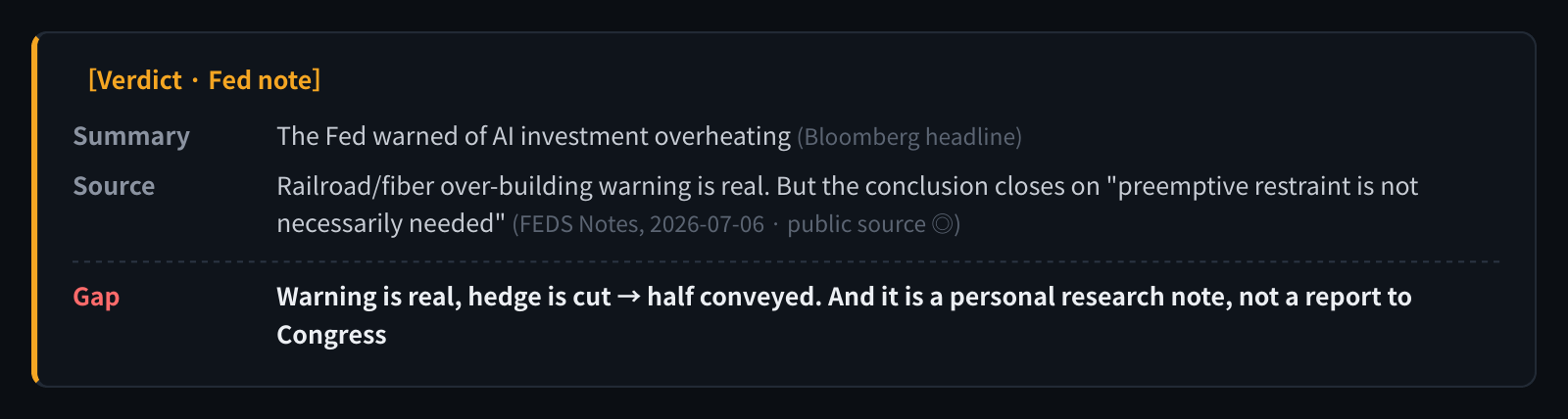
Start with the heaviest item on the list, because it was issued by the Federal Reserve. Unlike a brokerage comment or a press interpretation, the fact that a central bank flagged overheating carries weight on its own. The sentence that circulated in summary form was this: U.S. intellectual-property and equipment investment as a share of GDP had reached 11.33% in Q1 2026, near the 2000 dot-com peak of 11.49%, and the Fed had warned of AI investment overheating. Bloomberg's headline carried it as "Fed Says US AI Investment Share Is Near Dot-Com Bubble Peak."
The figures are accurate. From the source chart's data: 11.3329% in Q1 2026, 11.4857% at the 2000 peak, a gap of 0.15 percentage points. To here, summary and source agree. And the warning is real too. The note directly invokes the over-building of 19th-century railroads and canals and the dark fiber over-laid during the dot-com era, writing that if demand forecasts miss, AI could leave behind a similarly large capital overhang. The same concern is not confined to one document. The Monetary Policy Report submitted to Congress on July 10 noted that real equipment investment is largely tied up in AI infrastructure, and Governor Barr's February speech, invoking the same railroad and fiber cases, said that if AI disappoints, risk shifts from the labor market to the financial sector. The Fed's warning was not invented by a headline; it is real and repeated across several channels.
The problem is what comes next. The conclusion of the same note closes in the opposite direction from what the summary conveyed.
The note is titled "Do Major Technology Advancements Lead to Overinvestment?", its author a Fed economist, dated July 6, 2026. In its conclusion the note defines overinvestment as "not a mistake caused by irrational exuberance" — a rational process in which investors learn sequentially amid uncertainty about the scale of a technology. Its final three sentences are three questions and three hedges. Would AI generating productivity gains bring another investment boom — perhaps. Would it end in substantial overinvestment — possibly. Should investment then be preemptively restrained to avoid it — not necessarily.
That last hedge runs directly counter to the summary. The summary carried this note as a "warning of overheating," but the source pressed its own warning down, closing on the view that preemptive restraint is unnecessary. What the note left was warning and hedge at once — proximity to the dot-com peak, and the judgment that this does not necessarily mean overinvestment. Both faces sit in one document.
There is a secondary discrepancy. This is a FEDS Note — a short piece written by Board staff as personal views, which states outright that it reflects "the author's views and not those of the Federal Reserve Board." Some summaries referred to it as a report submitted to Congress. A document circulated as a policy signal was, in the source, one economist's research note.
This is the first fracture. The bear case was in the source. But what the summary conveyed was half of it — only the warning face. The hedging other half was cut from the headline. The structure revealed on opening one document — the bear case is real, but only one face of the source circulates — is the question for the documents that follow.
4. The same structure repeats in macro
The structure the Fed revealed — the bear case is in the source, but the summary conveys only half — is tested against two more macro documents. One came from inside the U.S. Treasury, one from Wall Street research.
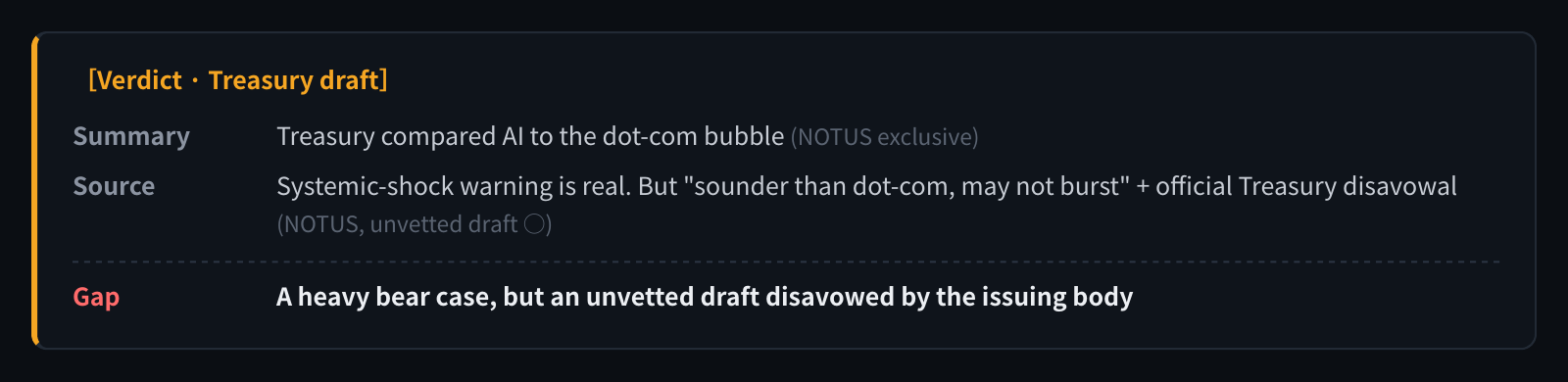
The Treasury's draft. On July 6, the investigative outlet NOTUS exclusively reported the existence of an internal Treasury draft. Reporting on the document, addressed to the Treasury Secretary and the Fed Chair, said it "compared AI to the dot-com bubble." The document does say that — an AI downturn would "send shockwaves across the entire economic ecosystem," hitting equities, private credit, data-center financing, cloud, chip makers, and utilities. What is heaviest is the difference from the dot-com era: the document held that today's AI companies are interconnected with one another and across markets, so that if investment dries up, the shock is broad. And unlike the dot-com era, with a lower share of retail investors, a sustained decline is passed more heavily onto the institutional investors central to economic stability.
But the same document takes its own weight off. It said today's AI companies are more mature, more profitable, and financially sounder than in the dot-com era, so that — in the reporting's words — "even if the bubble bursts, if it bursts at all, the shock could be cushioned." And there is a third layer: a Treasury spokesperson officially disavowed the report as "unvetted and not representative of the department's policy or views."
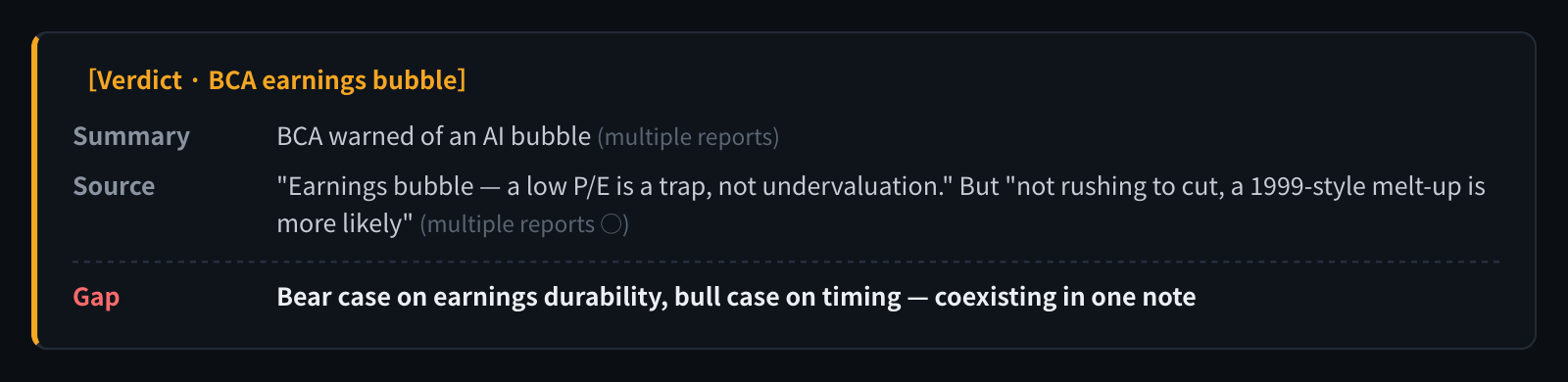
A name for earnings. The second document is a BCA Research note. The summary carried it as an "AI bubble warning." The source's argument is more precise, and its direction sharper. BCA defines this not as a valuation bubble but as an "earnings bubble." The core is here — a low P/E is not a signal of safety but a trap masked by unsustainable earnings growth. The crashed memory trio now trade at single-digit forward P/Es. The bull case cites that low P/E as evidence of undervaluation. BCA's logic inverts the premise.
But BCA too puts the opposite face in the same note: "All bubbles burst. But we are not in a hurry to cut our AI exposure right now." It nudged its 12-month equity weighting up, and saw a "1999-style melt-up" as the more likely path.
Two documents repeat the same structure. The bear case is real in the source — the Treasury's points to systemic risk, BCA's to the sustainability of earnings, both more concrete than the Fed's. But both carry the opposite face themselves. The summary conveyed only the front face each time.
5. The misreading called capex
If the macro documents' bear cases were mostly real in the source, the next cluster shows a different kind of discrepancy. Here the bear case the summary conveyed diverges from the source in direction, and the source's real bear case sits somewhere else. Three documents all concern capital expenditure.
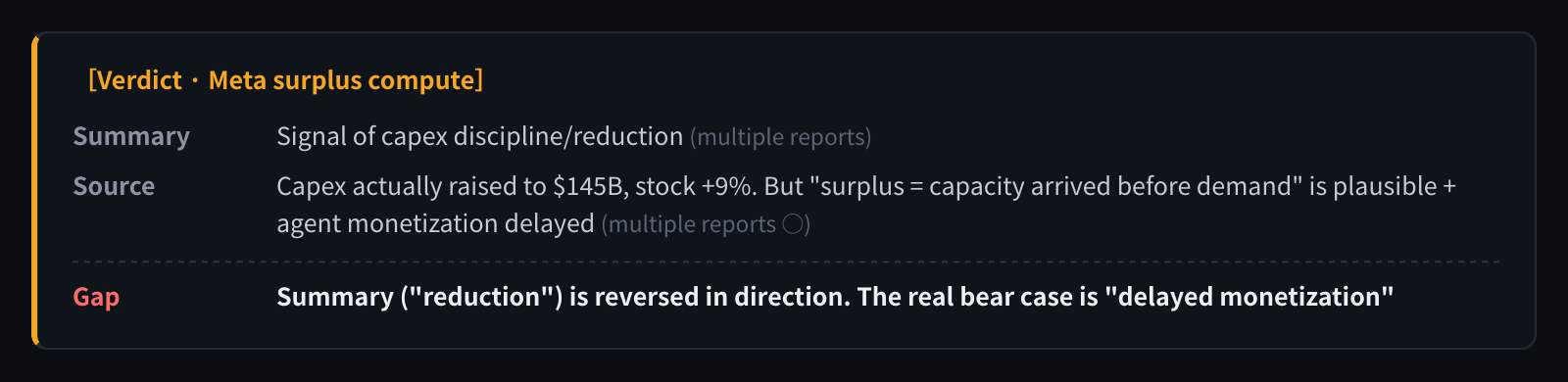
Meta's surplus compute. On July 1, when Meta said it could sell surplus compute externally, this circulated as a signal of capex reduction. One analysis carried it as "the start of capex discipline, confirmation of an AI infrastructure bubble." But the same day Meta raised its 2026 capex guidance from $115–135 billion to $125–145 billion — twice the prior year's $72 billion. Not a cut but an expansion, and the stock rose 9% that day. Zuckerberg explained the surplus sale this way: the option to sell if it turns out to be over-built is what gives the confidence to keep building. The "capex discipline" summary is the reverse of the source in direction.
But erasing the bear case entirely here is also a misreading. As one analysis put it precisely — leasing surplus is not automatically bullish. The lazy bull case is "every AI company needs every GPU forever"; the more honest version is "frontier compute is scarce, but mistimed compute becomes a rental." That surplus exists at all can be a signal that capacity arrived ahead of internal demand. Add to it that Zuckerberg internally acknowledged AI-agent development had not accelerated as expected over four months. The bear case the summary pointed at ("reduction") is wrong, but the real bear case ("has capacity outrun demand, is monetization delayed") remains in the source.
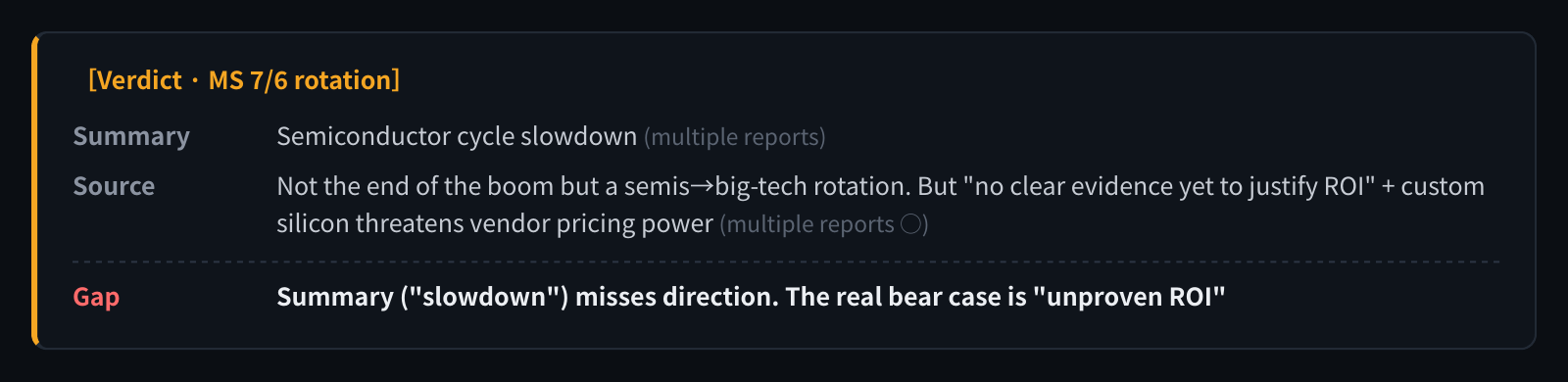
Morgan Stanley's rotation. The July 6 Morgan Stanley note circulated as a diagnosis that the semiconductor upcycle was ending. The source's argument is different. The author described a capital rotation from semiconductors to hyperscalers — not the end of the AI boom, but a shift in leadership. But the real bear case is in the same note. The source wrote that Alphabet and Amazon committed billions to lift semiconductor stocks, yet "clear evidence" that AI products generate revenue justifying that spending "is yet to be seen." Even the rotation's destination, the hyperscalers, is exposed to margin pressure and multiple compression if monetization disappoints. The summary's bear case ("cycle slowdown") was not it; the source's bear case was "ROI is not yet proven."
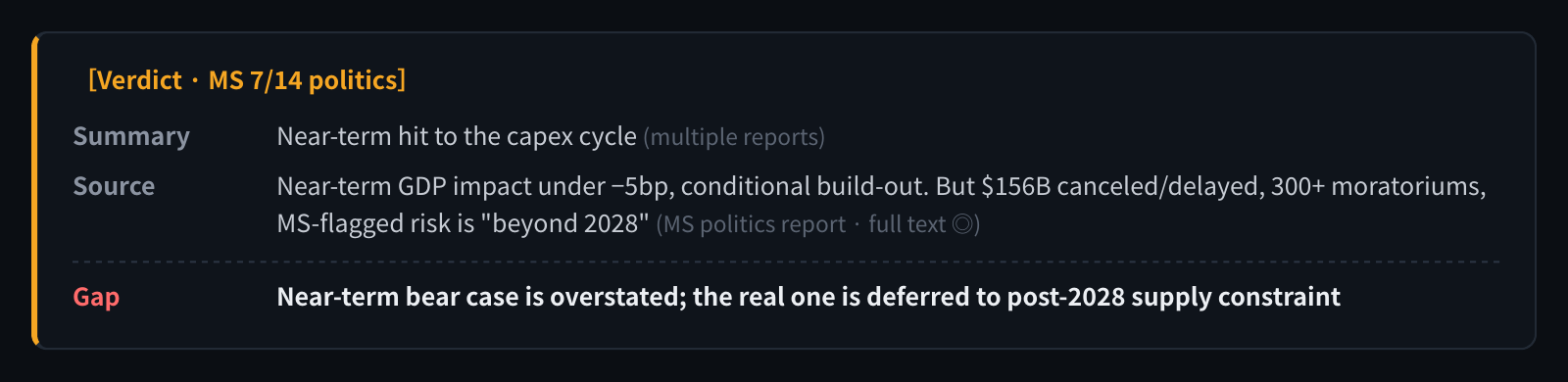
Morgan Stanley's politics. The July 14 Morgan Stanley note addressed community backlash to data-center construction. This circulated as grounds for a capex-cycle slowdown. The source's near-term judgment is closer to the opposite. Its base case is not a nationwide halt but "a slower, more conditional build-out," and the hit to 2026–27 real GDP growth from such delay is under 5bp. But the data beneath it is not light. Projects canceled or delayed came to $156 billion in 2025, $130 billion in Q1 2026 alone. Local moratoriums passed since 2023 exceed 300. And Morgan Stanley itself flags a larger risk — that political resistance slows compute deployment and delays AI adoption and productivity gains "beyond 2028." Not a near-term bear case. Its timing is deferred beyond 2028 — a real supply-side constraint.
Three documents head toward the same conclusion. The summary mispointed the bear case all three times — Meta was "reduction" but the source was an increase, MS July 6 was "cycle slowdown" but the source was rotation, July 14 was "near-term hit" but the source was beyond 2028. Yet all three sources carried a real bear case elsewhere — delayed monetization, unproven ROI, and post-2028 supply constraints. Where the summary pointed, there was no bear case; where the source pointed, there was.
6. Opening the trigger
If the earlier documents were narratives supplied throughout the decline, the two here sit closest to the mechanism of the fall itself. One is the report named as the trigger; one is why that trigger became an explosion.
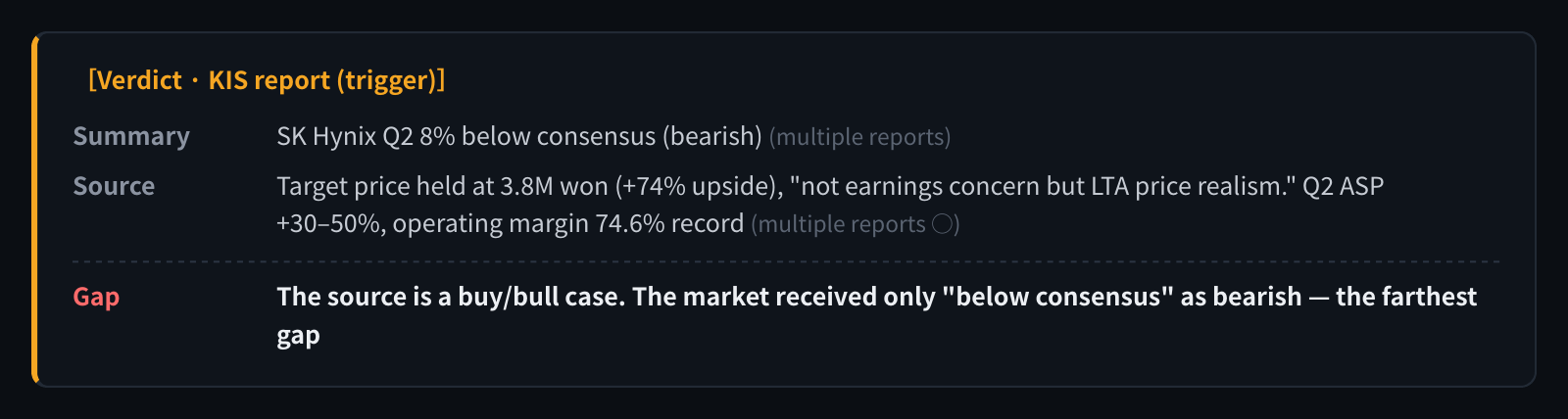
Korea Investment & Securities' report. On July 13, when a projection emerged that SK Hynix's Q2 results would fall below consensus, the stock dropped 15% that day. This report circulated as the trigger of the crash. The sentence conveyed to the market was one — Q2 operating profit will miss consensus by about 8%.
That miss is a fact. But the report's source stands in the opposite direction. Its title is "Estimates Made Realistic, Reflecting the LTA," and its target price was maintained at 3.8 million won — 74% above that day's close. The reason for the cut was not deteriorating earnings. The source states that lowering the Q2–Q3 estimates "reflects realistic price assumptions based on already-signed long-term agreements (LTAs), not earnings concerns." The same report estimated Q2 DRAM and NAND average selling prices up 30% and 50% quarter-over-quarter, projected a company-wide operating margin of 74.6% — a record high — and saw ASPs recovering to the market average once HBM4 mass production begins in Q3.
In other words, the report named as the trigger of the crash was, in the source, a bullish document presenting a buy rating with 74% upside. The market took one phrase from it — "below consensus" — and received it as bearish. This is the case in this report where summary and source stand farthest apart.
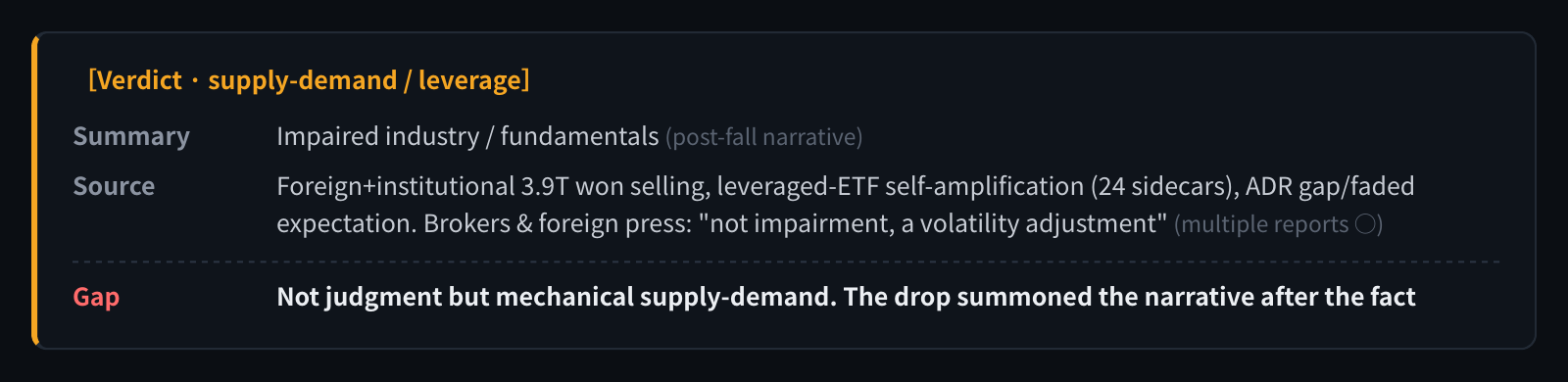
The structure of the explosion. If the trigger was a report, the amplifier was supply and demand. On July 13 alone, foreigners net-sold 1.7 trillion won and institutions 2.2 trillion — 3.9 trillion combined. Retail alone net-bought 3.8 trillion, catching the index at the bottom. The KOSPI broke 7,000 and a sidecar was triggered. What amplified this selling was structure. Since single-stock leveraged ETFs listed on May 27, the product buys more as it rises and sells more as it falls — a self-amplifying mechanism where selling begets selling in a down market. Sidecars have triggered 24 times since listing.
The brokerages agreed. This drop was "not the result of impaired industry fundamentals or the medium-term earnings trajectory, but a volatility adjustment reflecting, at once, the fading of the ADR-listing event, elevated earnings expectations, and the unwinding of leveraged positions." Foreign outlets did not read the drop as a signal of the end of the semiconductor boom either.
But the drop produced a narrative. As the decline deepened, the press began citing "doubt over whether that enormous spending will generate matching returns" as the reason for the fall. The bear narrative did not make the decline; the decline summoned the bear narrative. A record-earning stock collapsing on supply-demand alone is not accepted, and a fitting reason is demanded after the fact. Those reasons were the documents of the earlier sections.
7. Where the bear case stands
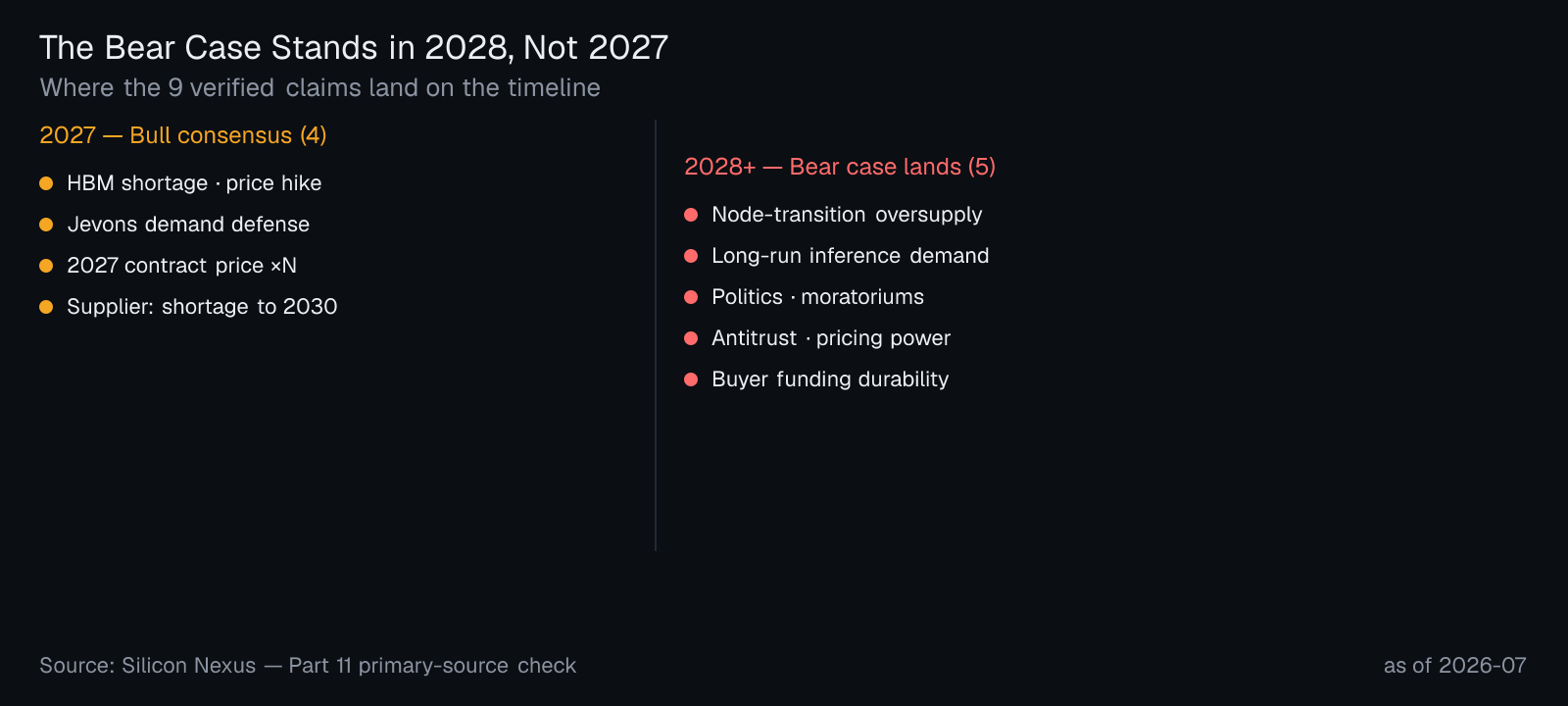
If the earlier documents were macro, capex, and the trigger, this section takes on memory's own fundamentals. And here this report's subtitle is grounded — the bear case exists. It just sits in 2028, not 2027.
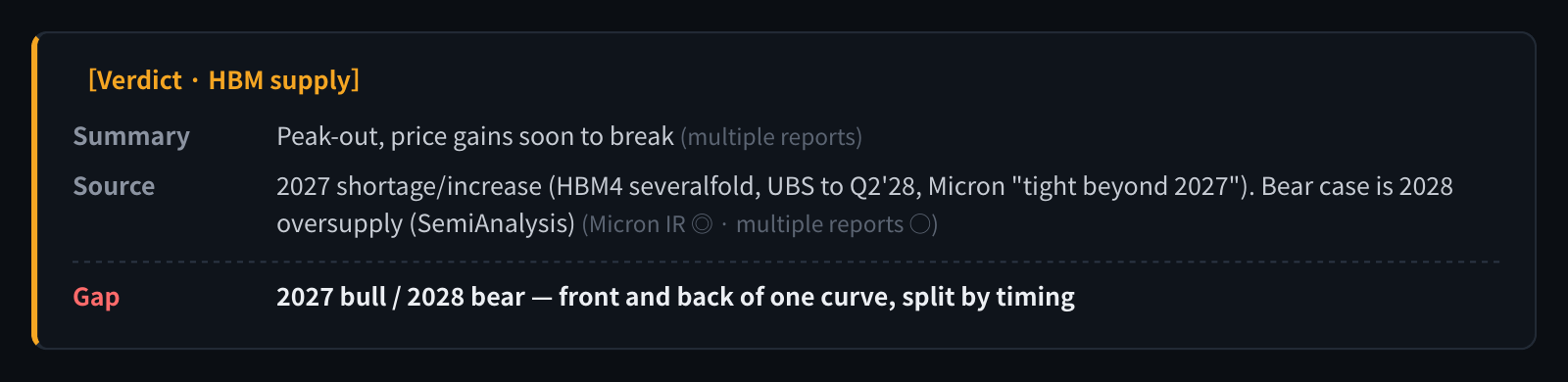
HBM supply. The market's peak-out fear is that memory price gains will soon break. The sources say the opposite about 2027. TrendForce and DigiTimes reported that 2027 HBM4 contract prices are being negotiated toward a "severalfold" increase, and UBS saw DRAM shortage persisting at least through Q2 2028. Micron said on its earnings call that conditions would stay tight "beyond calendar 2027," and that it could meet only half to two-thirds of core customer demand. Because HBM consumes nearly four times the DRAM wafer of commodity product, raising HBM eats commodity DRAM capacity and pushes total DRAM into shortage. New fabs will not yield meaningful volume within 2027. Shortage in 2027 is broad consensus.
The bear case sits in the year after. SemiAnalysis's memory model presents the mechanism. Node transitions constrain bit output early because yields are low — this is the "2027 bit-growth slowdown" Micron described — but as yield learning progresses and the transition scales, per-wafer bit output rises sharply. And node transitions do not stop even when demand weakens. So bit supply keeps rising into the following year, worsening oversupply and price declines. SemiAnalysis sees this cycle's peak around 2028.
Micron and SemiAnalysis do not conflict. They are the front and back of the same curve — 2027 is early in the node transition and short, 2028 is where the transition matures and tilts to surplus. Bull and bear split by timing.
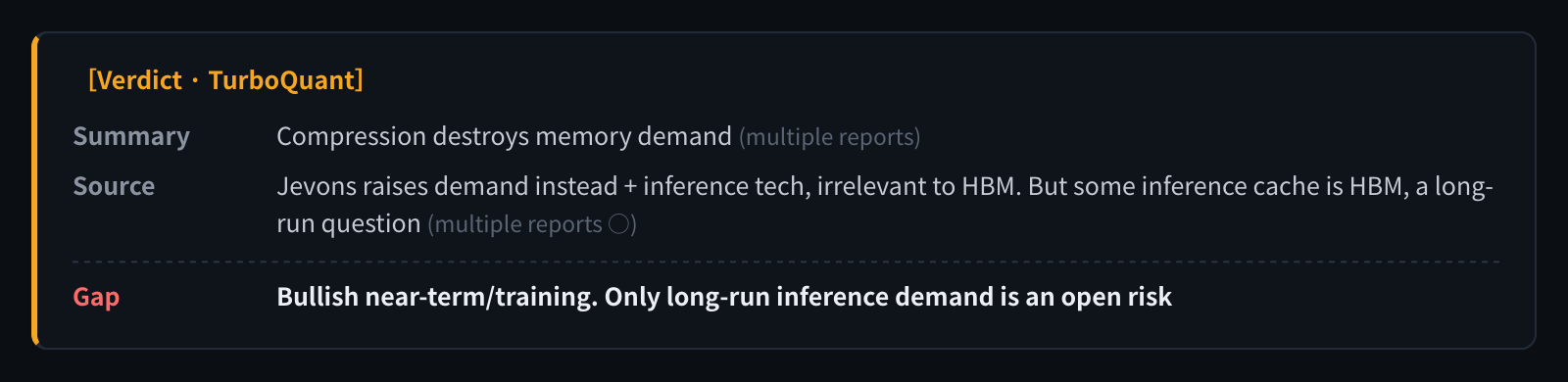
Memory compression. In March, Google's TurboQuant compressed inference-time memory sixfold. The next day SK Hynix and Samsung fell. It was read as a technology that reduces memory demand. The source's rebuttal is two-fold. One is the Jevons paradox — if efficiency lowers AI operating costs, applications proliferate and total demand rises instead. The other is a matter of target. TurboQuant is inference optimization, largely irrelevant to the HBM used in training — and HBM is precisely what the crashed stocks lead with. In the very quarter the compression was announced, TrendForce projected standard DRAM contract prices up 55–60% quarter-over-quarter.
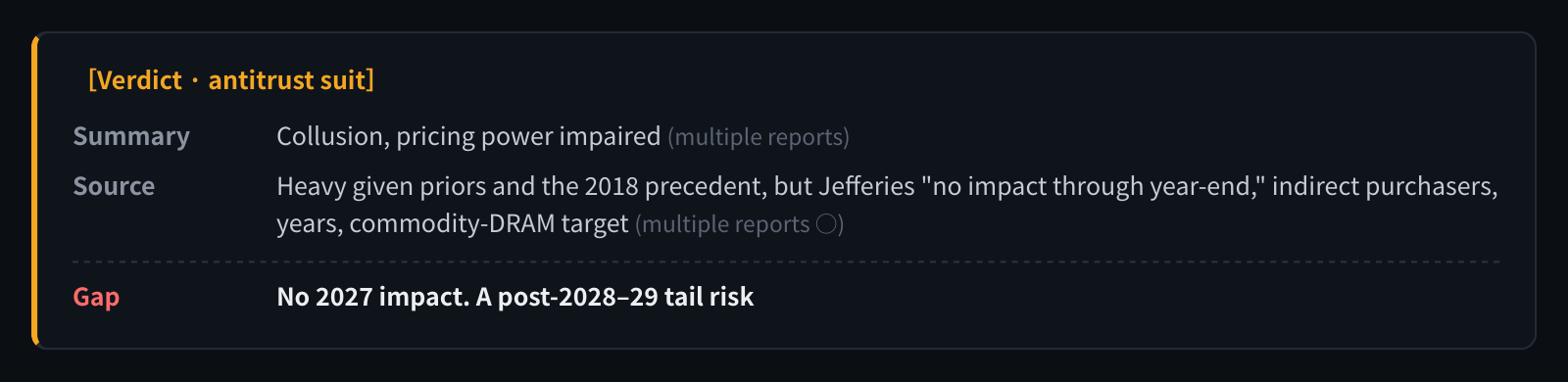
The antitrust suit. On June 25, a DRAM price-fixing suit was filed in the U.S. against Samsung, SK Hynix, and Micron. Plaintiffs allege the three deliberately curtailed commodity DRAM production "under the pretext of the HBM transition" to collude on a 700% increase over four years, seeking treble damages. Samsung and SK have a prior record of guilt and fines for DRAM collusion in the early 2000s, and a similar class action existed in 2018. But the timing splits again. Jefferies saw the suit having no impact on memory prices at least through year-end. The plaintiffs are individuals and small businesses — indirect purchasers — so the case takes years, and the target is commodity DRAM, not HBM. Not a 2027 earnings risk, but a post-2028–29 tail risk to pricing power.
Three items point to the same place. 2027 is bullish — shortage, price increases, Jevons demand defense. The bear case is real, but all of it sits in the next stage — 2028 oversupply, the long-run inference-demand question, post-2028 litigation risk. The summary conveyed the bear case in the present tense, with its timing erased. In the source, the bear case is future tense.
8. The one that survives
Eleven documents have been opened. The bear case was mostly real in the source; only the summary conveyed half (Fed, Treasury, BCA), pointed at the wrong place (Meta, Morgan Stanley), or erased the timing (HBM, suit). The trigger was a bullish document in the source (KIS), and the body of the crash was supply-demand, not fundamentals. And the real bear cases left in the sources flowed in one direction — the Treasury's "money dries up," Morgan Stanley's "ROI is unproven," BCA's "earnings do not last." The three sentences are three expressions of one question. Can the buyer recover this spending in cash?
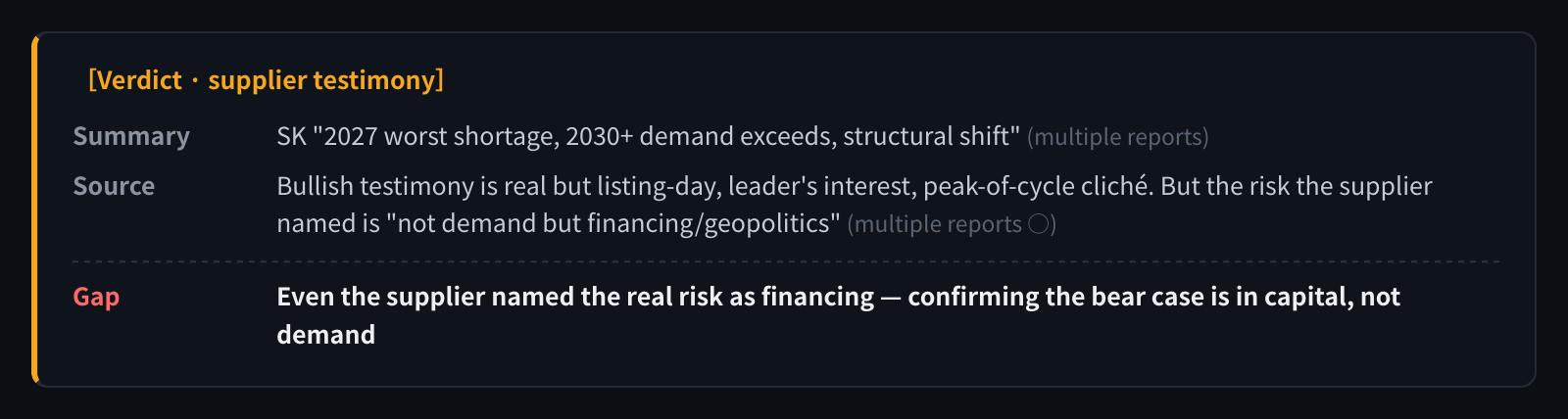
Ask the supplier, and the answer points paradoxically to the same place. SK Hynix sees 2027 as "the worst year in the industry's history from a supply standpoint," demand at 5–6x supply, and demand exceeding supply even beyond 2030. "Not a cycle, but a structural shift." Powerful bullish testimony — with the caveat that it came on listing day, from the interest of the HBM leader. But what matters is what it did not name as a risk. The risk SK Hynix named was not weakening demand — it was geopolitics and enormous capital requirements. Even the vanguard of the bull camp located the real danger not in memory, but in the money of the side buying it.
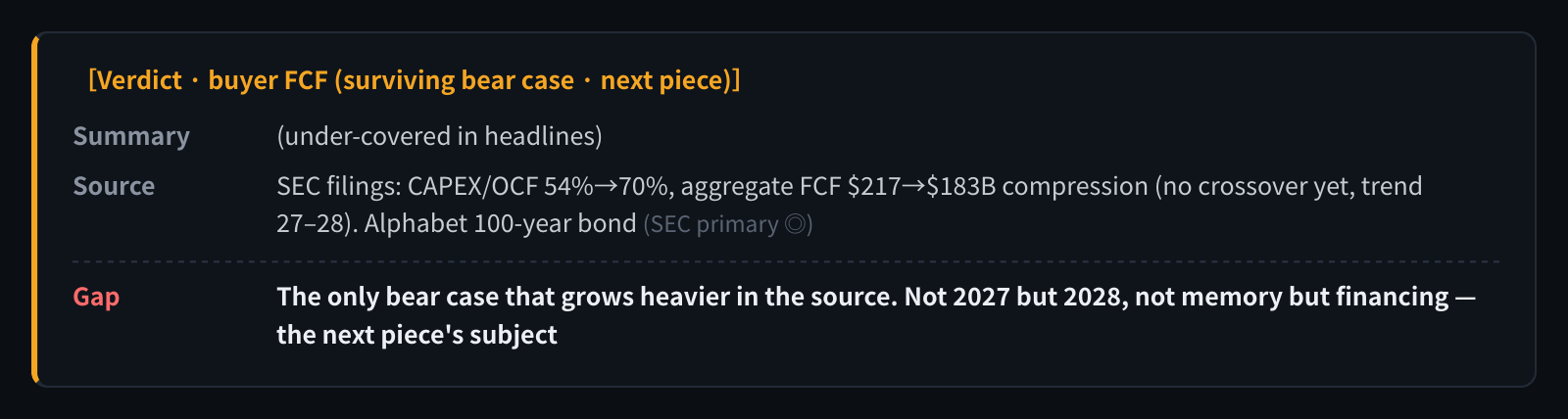
The trajectory of that money already shows its direction in the filings. Hyperscaler capex as a share of operating cash flow rose from 54% a year ago to 70% in Q1 2026, and aggregate free cash flow compressed from $217 billion to $183 billion over the same span. Still positive — the crossover has not happened. But the two curves are narrowing, and Alphabet has issued a 100-year corporate bond. A company that built data centers with its own cash has begun taking on century-long debt.
This is the one left at the end of eleven documents. The others were half in the source, or the wrong place, or not 2027. But this one — the sustainability of the buyer's financing — stands on filed data, and the supplier itself acknowledged it as a risk. That the market sold memory in the week of record earnings was not selling 2027's memory. The market sold, in advance, the question of 2028 — can the side supporting this spending hold until then?
That question is beyond this piece. The trajectory of that capital — when capex crosses operating cash flow, what the 100-year bond signals, which one breaks first — the next piece opens, one filing at a time.
9. Eleven, on one page
| Claim | What the summary said | What the source said | Gap | Grade |
|---|---|---|---|---|
| Fed note | Warned of AI overheating | Railroad/fiber warning real, but "restraint not necessary" | Warning real, hedge cut | ◎ |
| Treasury draft | Compared AI to dot-com bubble | Systemic-shock warning, but "sounder than dot-com" + disavowed | Heavy but unvetted/disavowed draft | ○ |
| BCA | Warned of AI bubble | "Earnings bubble — low P/E is a trap," but "not imminent" | Bear on earnings, bull on timing | ○ |
| Meta surplus | Capex discipline/reduction | Capex raised to $145B, but delayed-monetization signal | Summary reversed. Real bear = monetization | ○ |
| MS 7/6 | Semiconductor cycle slowdown | Big-tech rotation, but "ROI evidence yet to be seen" | Summary misses direction. Real bear = ROI | ○ |
| MS 7/14 | Near-term capex hit | Near-term −5bp, but moratoriums · post-2028 constraint | Near-term overstated, bear is post-2028 | ◎ |
| KIS (trigger) | 8% below consensus (bearish) | Target held +74%, "LTA price realism" | Source is bullish — farthest gap | ○ |
| Supply/leverage | Impaired industry | Mechanical (3.9T won · 24 sidecars), not impaired | Drop summoned the narrative after | ○ |
| HBM supply | Peak-out, prices to break | 2027 shortage/increase, bear is 2028 oversupply | 2027 bull / 2028 bear, split by timing | ◎○ |
| TurboQuant | Destroys memory demand | Jevons raises demand · irrelevant to HBM | Bullish near-term, only long-run inference open | ○ |
| Antitrust suit | Impairs pricing power | No impact through year-end, commodity DRAM, years | No 2027 impact, 28–29+ tail | ○ |
| Buyer FCF | (under-covered) | CAPEX/OCF 54→70%, FCF compression · Alphabet 100yr bond | The only one that grows — next piece | ◎ |
(◎ public primary source verified directly · ○ multiple reports agree)
The table reveals one shape. Across the eleven claims, there is none whose bear case is not real in the source. But there is also none that stands as the summary conveyed it. The bear case was conveyed in half (Fed, Treasury, BCA), pointed at the wrong place (Meta, Morgan Stanley), reversed in direction (KIS), or had its timing erased (HBM, suit, politics). The circulated bear case and the source's bear case differed every time. And only the twelfth — the buyer's financing — grew heavier in the source instead. That is the next piece's subject.
Bottom line.
In the week it set record earnings, memory crashed 25–43% from the peak. That fall began the day before earnings were reported; earnings bought a two-day rebound, but that rebound was repaid in a single day. The ignition of the crash was not fundamentals but the overheating of a price up 700%, and the body was supply-demand — rotation, valuation give-back, leverage unwinding. On top of it, bear narratives accumulated in the wake of the decline. Open the source, and their bear cases were mostly half, or the wrong place, or not 2027.
The one bear case that grew in the source was singular. Not memory but the side buying it — can the hyperscalers recover this spending in cash? It stands on SEC filings, the supplier itself acknowledged it as a risk, and it sits not in 2027 but in 2028. The market did not sell 2027's earnings; it priced, in advance, the question of 2028. This observation predicts no direction. It only records what the market is repricing — not earnings, but the sustainability of the capital that holds those earnings up.
The trajectory of that capital — when capex overtakes operating cash flow, what the 100-year bond signals, which one breaks first — the next piece opens, one filing at a time.
This piece is a record of observation at the industry and cycle level, not individual investment advice. Public primary documents were verified directly (◎); where the source is paywalled or unpublished, the agreement of multiple reports was confirmed (○). Cited figures are per each source/report and re-verified at publication.
If this analysis was helpful · ☕ Support Us · ✈️ Telegram